
World War II
1955: unveiling of the Departmental plaque for the war dead (World War II), and the Federation House memorial for World War I and World War II service personnel
All the painstaking work carried out by so many individuals and groups came to fruition in November 1955 when two significant ceremonies were held.
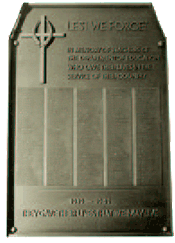
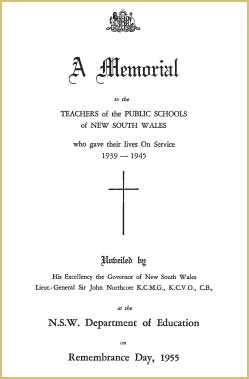
On Remembrance Day, Friday, 11 November His Excellency the Governor of New South Wales, Lieutenant-General Sir John Northcott, KCMG, KCVO, CB attended a service at the Department of Education for the unveiling of the memorial tablet containing the names of NSW public school teachers who gave their lives in service in World War II. All returned service men and women in the metropolitan area had been given permission to leave their schools in time to be at the Department by 2.45 p.m. Prior to the commencement of the service the Governor inspected a Guard of Honour of teachers who served their country in World War II.47
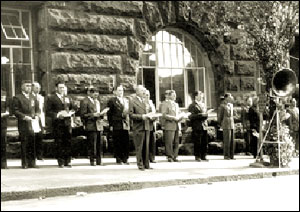
According to a copy of the proceedings held by the Department’s History Information Officer, the service commenced with the hymn, “O God, Our Help in Ages Past”, played by the Eastern Command Band.
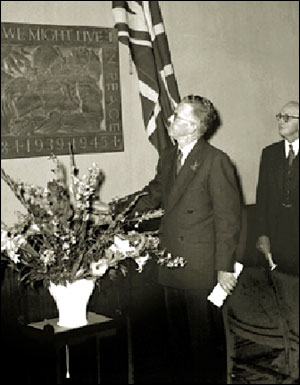
The Deputy-Premier of NSW and Minister for Education, the Hon. R J Heffron MLA, delivered the address and invited the Governor to unveil the memorial in the Department’s main entrance area, after which prayers were said by Major-General the Reverend C A Osborne, CIE.
Following the playing of “The Last Post” and two minutes silence the names of the fallen were recited, and the gathering united in saying the well-known lines from Laurence Binyon’s (1914) “For the Fallen”, verse 4:
They shall grow not old, as we that are left grow old;
Age shall not weary them,nor the years condemn.
At the going down of the sun and in the morning
‘WE WILL REMEMBER THEM’
The service concluded with the “Reveille” and the National Anthem.
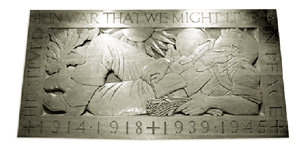
This commemoration was followed eight days later, on Saturday, 19 November 1955 by the unveiling in Federation Hall in Phillip Street of the memorial plaque crafted by Mr Paul Beadle in Queensland maple. Senior officers of the Federation had conferred with representatives of the Teachers Sub-Branch and this day was chosen as the date nearest to Remembrance Day. The Federation invited the Minister for Education, the Director-General, the Deputy Director-General, the four former Presidents of the Federation, Miss L Woodcock, all members of the Teachers Sub-Branch, and all teacher ex-servicemen and ex-servicewomen to the ceremony.48
The proceedings commenced shortly after 11.00 a.m. when, as arranged earlier, Federation Council concluded. As reported in a front page account in Education, the President, Mr D A Taylor, introduced the Director-General, Dr Harold Wyndham, representing the Minister, and the Deputy Director-General, Mr Norman Drummond, a veteran of World War I, who would unveil the plaque.49
In addressing the gathering before the unveiling and dedication, Dr Wyndham referred to the significance of memorials throughout history and dwelt on the meaning of the plaque to be unveiled. He said, among other things:
It means, first of all, I suggest, a call to remembrance.
…sixteen years have already gone since that fateful Sunday evening when we knew that, once more, we were at war…. With every passing year, the call to remembrance will become more imperative.
Yet we must recall that this memorial means more than personal remembrance of our colleagues and pride in their achievements. This memorial is an outward and visible sign of our indebtedness to…[them] and to all their fellows.
These men made it possible for you and me to live in a free Australia. For the preservation of all those things which we take so much for granted in this democratic life of ours, we must remain forever indebted to…[them]. Our freedom of assembly, freedom of speech, our freedom of worship have, not once, but twice in the lifetime of most of us, been bought with the greatest price a man can pay.
…But our obligation is much greater than that. They made it possible for us to lead worthwhile lives. We dishonour the men to whom this memorial is raised whenever we fall below the highest of which we are capable in thought and word and deed.
These men died, not that we should waste our heritage, but that we should add to it. Perhaps on no other profession [the teaching profession] does this obligation weigh more heavily … 50
Mr Drummond, in unveiling the memorial said that the plaque was dedicated to the memory of teachers from our public schools who, in the words of the inscription, “SERVED IN WAR THAT WE MIGHT LIVE IN PEACE”. He felt that he represented all present in paying tribute to their gallantry and self-sacrifice. “As we read the names of the fallen”, Mr Drummond said,
each of us recalls some whom we knew as school mates, as college friends, as colleagues in the teaching service, and in some cases, as cobbers on active service. As I mention a few by name it is that I, in these solemn moments, wish to recall them vividly; and in the pauses that I shall make, you and I, each recalling other names, shall together fill this hall with fragrant memories of them all…
He continued:
…They believed in the free spirit of man, that it never would or could be lastingly enchained; and that life without liberty was not worth keeping.
They loved deeply their kindred, their home, their country – loved them with selfless devotion, bravery in action and sacrifice in full.
They hoped that by their service they would help to preserve the best they knew, and afford to a darkened world a brighter tomorrow. Their torch of hope, aflame when our heritage was in danger and our very homes in peril, was never extinguished; and freedom, with faith and hope and love, though still challenged, remains within our keeping.
They gave themselves.
Presently, as the Last Post sounds, we shall remember their last resting places. But the night passes, and as we hear the Reveille, may it awaken us to a sense of the dawning of a new day with life pulsating. Then, as the notes of the bugle die away, may we, intently listening, recall the words of Pericles: ‘And the trumpets shall sound for them on the other side.’
Mr Drummond then invited all present to share with him the act of dedication:
With reverent hearts, with gratitude and in deep respect and affection, we remember the teachers of our public schools who served in the World Wars of our time and whose names are inscribed forever on the rolls of these valiant dead. We commend their spirits to God. We invoke His blessing upon all that they hold dear, and the cause of freedom for which they died; and we now solemnly dedicate this plaque to their memory forever. Amen. 51
The dignified and impressive ceremony concluded with the sounding of “The Last Post”, the observation of two minutes silence, the repeating of the ode “For the Fallen”, and the playing of the “Reveille”. The bugler was North Sydney Boys High School student, Geoffrey Yates.52
Mr Beadle was among the many present at the dedication of his carving. Among his other designs are the 45 feet high finial eagle of Australia’s National Memorial to the USA, Canberra, and panels in Newcastle, Cessnock, South Australia, National galleries, State galleries, New Zealand galleries, and the British Museum.
A full of list of names from the World War II memorial to fallen soldier-teachers is at Appendix F.
1963: the placement of the Book of Remembrance in Federation Library