
Soldier-Teacher War Memorials
World War I – World War II – Post World War II
Preface
At a Teachers Sub-Branch, RSL meeting a few years ago, the President, Geoff Falkenmire, organising the Anzac Day Service, suggested that I should give the gathered personnel some facts about the honour boards.
As I served the Soldier-Teachers Memorial Committee (World War II) as Secretary during its final stages, I had some memories of the organisation of the World War II memorial in the Department of Education from vague memory recalls.
I decided I should know more about the subject and set about doing some research, perhaps an hour or so. This publication is the result of research covering several hundred hours along with the support of Dr Ken Boston, the Managing Director of TAFE NSW and Director-General of Education and Training, John Hennessy, the General Secretary of the NSW Teachers Federation, Mary Schmidt, Senior Librarian, NSW Teachers Federation, Mary McPherson, History Information Officer, Department of Education and Training, and many others.
Memories have been stretched and searched to find forgotten information for use in publishing this material on the World War I, World War II and Post World War II memorials.
During 1988-89 a decision was made to move the then Department of School Education from its Bridge Street premises and to offer the building for sale with vacant possession.
The Sub-Branch saw fit to query the Minister concerning the location of the World War I and World War II memorials. Early in 1990 the removal of the honour boards and their relocation to the Fanny Cohen Memorial Hall on Observatory Hill were arranged. Also relocated was the Book of Remembrance and its cabinet, which the NSW Teachers Federation had some years earlier asked the Department to keep at Bridge Street after the Federation Library moved from Phillip Street to Sussex Street.
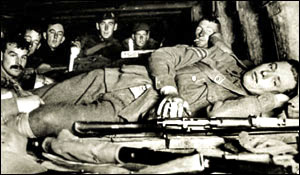
Australian soldiers sleeping quarters
in the trenches, France, 1917
Accordingly the 1991 Anzac Day service was held for the first time at the Observatory Hill site. In his address on this occasion Dr Fenton Sharpe, the Director-General at the time, indicated that later in the year the Department would “…arrange a formal service to dedicate these memorials in their new home.”1 Research suggests, however, that this did not occur, possibly because of the substantial administrative and personnel changes which took place late in 1991 and early in 1992.
The Anzac Day Service was held for a number of years at Observatory Hill. A highlight at one ceremony was the attendance of three Russian teachers with Phil Cross and Ray Cavenagh, senior officers of the NSW Teachers Federation.
In 1998, the Federation sold its building in Sussex Street and moved to Mary Street, Surry Hills. Refurbishment and redesign of the building took a period of time and the soldier-teachers memorial, the wood sculpture by Paul Beadle, was kept in storage until the rededication by the Federation President, Sue Simpson, on 18 April 2000.The memorial had been originally unveiled at Federation House in Phillip Street in 1955 and had moved previously with the union to Sussex Street.
Australian soldiers sleeping quarters
in the trenches, France, 1917
The sculpture, acknowledged as a major wood carving, is now suitably displayed in the foyer of the NSW Teachers Federation Library.
In 1996 the State Office of the then Department of School Education returned to Bridge Street. While it was necessary to alter the layout to satisfy administrative changes and ensure efficiency, the heritage features were retained and the war memorials were “brought home” from Observatory Hill. The Director-General, Dr Ken Boston, consulted the Teachers Sub-Branch, RSL over the placement of the memorials, and they were prominently positioned in the atrium, the surrounding area and in the Bridge Street foyer in time for the Anzac Day service. Dr Boston showed outstanding initiative over their relocation and the design of the new area on Level 2. The memorials included the World War I memorials and the Book of Remembrance in its cabinet. The World War II memorial plaque and the Hereford House World War I memorial were placed in the Bridge Street entrance.
The memorials on Level 2 were supplemented in 1997 when a Roll of Honour was dedicated to Departmental officers who served in Vietnam, New Guinea, Malaya, Korea, Japan and Crete.
All memorials are prominently displayed and each is honoured at the Anzac Day morning service every year.
Arising from research originally instigated by Bruce Enderby, and queries from ex-service teachers about their names not appearing on any memorial, or in the Book of Remembrance, the Department asked Katherine Lundberg, Project Officer, Public Relations Directorate, to undertake an investigation.
Ms Lundberg found that the names of many student teachers who had served in World War II had not been listed. I believe they were not listed by the Public Service Board as they had never been employed by the Department, and were not listed by the Superannuation Board as they were never enrolled as contributors. Ms Lundberg also found that there were names of soldier-teachers that were not recorded. Building on a list of soldier-teachers compiled by Steve Gregg of Personnel Directorate in 1994-5 following Mr Enderby’s original request, a revised list was compiled to include as many names as could be identified.
Dr Ken Boston agreed that these names be placed on the new World War II soldier-teachers honour board which was dedicated on Anzac morning 2001.
Tom Spencer
27 April 2001