
World War I and the original memorials
1921: Unveiling of the memorial tablet to fallen soldier-teachers, and the soldier-teachers honour board
FOR GOD AND COUNTRY
Probably because the memorials were located in two separate entrances of the Department and there was the need to accommodate an extensive gathering at the ceremony on 24 September 1921, the organisers decided to have very large photographs of the memorials unveiled in King’s Hall, Hunter Street.
Prior to their arrival at the venue at 11 a.m., His Excellency the Governor of New South Wales, Sir Walter Davidson, KCMG and Dame Margaret Davidson, DBE, accompanied by the Right Rev. Dr Long, Bishop of Bathurst, were received at the Department of Education by the Minister for Education, the Hon. T D Mutch MLA, Mr Peter Board and officers of the Department and the Teachers Federation. The official party then inspected the two memorials.17
The Vice-Regal party was later received at the King’s Hall by a Guard of Honour of ex-soldier-teachers from all parts of the State.18 The ceremony was then carried out under the chairmanship of Mr E Dash, President of the Federation. The complete order of proceedings, reported in the 15 October 1921 edition of Education 19, is reproduced on the following page.
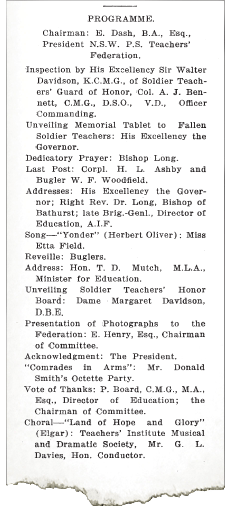
The Governor’s speech at the unveiling of the framed photograph of the memorial to the fallen was reported as follows in Education:
His Excellency…appropriately quoted from the speech of Pericles to the Athenians, and drew therefrom the lessons of the recognition of the noble spirit of true men of all time: that they would give their lives for the cause in which they believed, for the freedom of themselves and their country.
He spoke of the time, seven years ago, before the catastrophe of the Great War fell upon the world. The British nation, not a war loving people, had thrust upon them the defence of freedom of government and freedom from despotism. The whole Empire had rallied to the call, both men and women. To these latter His Excellency specially dedicated the gratitude of the nation. Teachers would have been recreant to their calling had they not responded, but there was no semblance of non-recognition of the great duty that teachers had always set before their pupils; the teachers responded, as it was known they would, and the number who fell showed how zealously and sacrificially they had undertaken the most exacting and most dangerous enterprises of the struggle.
Their deeds must never be forgotten. The memorials on the walls of the Department and upon the walls of the future home of teachers, their Institute, would ever remind the future generations of the obligations of posterity to those who won for them the freedom they inherit.
The lessons of the Great War would be taught by teachers imbued with the spirit of true recognition of their fellows’ sacrifice, and the future peace of the world would be more assured by the noble example of teachers who not only taught the principles of peace, but gave their lives in defence of those principles.20
The dedicatory prayer following the unveiling was said by Bishop Long, former Brigadier-General and Director of Education, AIF.

Dame Margaret Davidson, DBE later unveiled the framed photograph of the honour roll recording the names of those teachers who enlisted. Following this Mr E Henry, Chairman of the Soldier-Teachers Memorial Committee, presented this framed photograph and the one unveiled by the Governor to the President of the Teachers Federation. Unfortunately, at the time of the printing of this history, these photographs could not be located.
The various items “were rendered with charm and full appropriateness….” Following the moving finale of Elgar’s “Land of Hope and Glory” the “Soldier Teachers lunched together.”21
The final meeting of the Soldier-Teachers Memorial Committee was held at the Department of Education on 29 October 1921. The 15 December 1921 edition of Education contained the following remarks about this occasion:
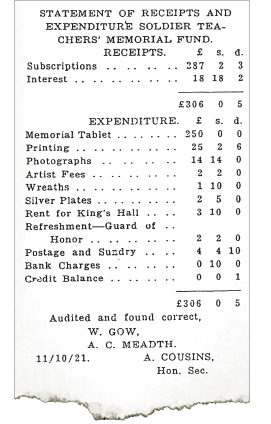
The Secretary reported that matters in connection with the fund had all been satisfactorily completed. The Treasurer submitted an audited Balance Sheet [below]… showing a credit balance of one penny. In view of this unique piece of high finance, the committee unanimously decided that the balance, suitably inscribed, should be handed to the Treasurer as a souvenir from his colleagues. Special votes of thanks were recorded upon the minutes, for valued services rendered, to the President and Council of the Federation, Sectional Associations, the Editor of ‘Education’ and Col. Bennett, CMG, OC the Guard of Honour. It was decided to publish [the] balance sheet and final lists of subscribers in “Education”, and “The Education Gazette”, [and] also to ask the Federation Council to allow the committee’s records to be permanently stored in its archives…
Valedictory references appropriate to the occasion were then voiced by the Chairman and other members, together with appreciation of the work of the Executive Officers… [Messrs Henry, Cousins and Berman].
With the reading and signing of the minutes passed out the “last survivor” of the old Teachers Association, from which the committee had received its commission.22
One can understand the element of euphoria that seems to emerge in this report. The committee members had worked tirelessly and commendably. They had been praised by the Governor and many others. They were also possibly feeling a release from a responsibility which, though readily accepted and even cherished, brought with it frequent sad reminders of departed friends. It is ironic that only a generation after this “war to end all wars” a similar committee would be convened to commemorate the efforts and sacrifices of yet another large group of teachers involved in a further massive and awful conflict.
The names recorded on the two memorials unveiled on 24 September 1921 are listed in Appendices A and B. Those listed on the Hereford House Reunion Club Roll of Honour 1914-1918 are recorded in Appendix D.