
World War II Soldier-Teacher Honour Board
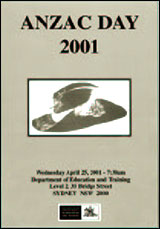
ANZAC Day 2001: Unveiling and dedication ceremony
Alarge and representative gathering met at 7.30 a.m.
on 25 April 2001 in the Atrium of the Department’s Bridge Street office to commemorate ANZAC Day and to witness the unveiling and dedication of the World War II soldier-teachers honour board.66
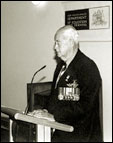
In his opening remarks, Mr Geoff Falkenmire OAM, President of the Teachers Sub-Branch, RSL welcomed the official party and all those gathered in remembrance. He especially referred to Mr Rusty Priest AM, the State President of the RSL, who was unexpectedly able to attend despite his extensive duties on this very special day.
Among his comments Mr Priest said:
… Iam aware of the great contribution that teachers have made, not only to the education of our children, but more importantly to the defence of their nation. They suffered grievously in many of the wars and conflicts so I thought it appropriate that I, as the president of the largest ex-service organisation, should be present … when you unveil the new memorial and simply just…say thank you for a job well done …67
Prior to unveiling the honour board Dr Boston, the Director-General, said:
The board lists all the diggers and nurses and others that we know of who were teachers, men and women who went to the 1939-45 war. The first thing you will notice when you look at the board is the incredible number of names. There are 2,532 names … and the astonishing thing is that that is actually 23 per cent. of the people who were employed as teachers at that time. I find that an astonishing figure. What other profession, what other walk of life, made such a commitment? Twenty-three per cent. of the teachers in the NSW Education Department went to war to serve their country in that period. You will find on the board, too, that there are trainees, student teachers, a very large number of them killed while serving. You will find one person, Mr Hopman, who was awarded a Croix de Guerre by the French and I understand that only 40 people who were not French nationals were awarded the Croix de Guerre during the 1939-45 war – a remarkable distinction.
… The board shows you a most noble generation, the generation that has earned our undying respect and gratitude, and it has been a great privilege to play a role in putting their names on the board, an honour board which will, in fact, last forever. Long after this building has gone or been turned into something else, all the honour boards, of course, will persist. They will be taken and kept and treasured and the names of those teachers, 2,532 of them, 23 per cent. of our workforce, will last forever.68
During his remarks Dr Boston thanked all of those who had made the completion of the board possible and especially referred to the “incredible research” undertaken by Kathy Lundberg of Public Affairs, and the ready co-operation of theTeachers Sub-Branch and the NSW Teachers Federation. He commended Tom Spencer and others mentioned in the Foreword and Preface of this book for their work in making the publication possible.
Mr Geoff Falkenmire, in performing the dedication, referred as follows to both the new honour board and to its predecessors:
… these memorials contain more than just a list of names. The people noted here are those who have offered everything they had in every age and in every land. Men have raised memorials to those who fell in battle and those who have offered themselves completely. Indeed, it is the responsibility of the elders of every nation, throughout time, to let their children know what sacrifices have been made for them and who made them.
These memorials are an outward and visible sign of our indebtedness to these … men and women … They made it possible for you and me to live in a free Australia. We are eternally in their debt for all the freedoms that we enjoy but which we sometimes take so readily for granted. All these things and more you have heard many, many times when you listened to speeches about dedications. But in addition to these things … there are … factors which weigh heavily on my mind particularly, as matters of concern.
When I look at the [new] board, firstly I think they were all so young. So very, very young. We don’t see the ages … but if you were in Lae cemetery they have the ages written on the stones, of the men who were there, and the average age, I suppose, would be about 22. And on the gates of the Armidale Teachers College, is written that beautiful piece from Pericles who said: “They offered on the altar of their high ideals the precious blossoms of their eager youth.” And so it was in schools and colleges and universities all over the land.
The second thought that comes to me is to think of the mothers and the fathers, brothers, sisters, sweethearts and all those who loved these people; and that interminable wait they had for the pastor, the policeman or the postman who came with that dreadful telegram at that time. And these people waited 24 hours a day, 365 days a year, and those people should be remembered too, but you might say – why remember them? It is because what these people whose names are recorded would want.
One further thought comes to me… consider how it would have been had there been no war at all. What children would have been born to these names [of the war dead] that are on this board? They would have grown up, married and had their own children. In other words, those names represent a world of Australians that never had a chance to exist. It is not just these people we have lost. We have lost their progeny forever. When a man gives his life or a woman gives her life,… in such a dedication time as this I think it is worthwhile to quote Shakespeare….
And you can say this…: “Take him and cut him out in little stars, And he will make the face of heaven so fine, That all the world will be in love with night, And pay no worship to the garish sun.”69
In addressing the gathering on the incomplete draft of this book, Ms Sue Simpson, President of the NSW Teachers Federation, made the following points:
… Tom [Spencer] … has worked very closely with the Federation because I would have to say that it’s the Federation Council Minutes, Executive Minutes and the Federation Journal, “Education”, that contained so much of the information on how those honour boards were funded, and their general history.
He has been assisted in the Federation by the Federation’s Librarian, Mary Schmidt … [Thanks were also extended to the Department and to the staff members present and past referred to in the Foreword, Preface or in Dr Boston’s remarks.]
importantly, the Department and Ken Boston have supplied the money to allow every school in the State to have a copy of this publication when it will finally be ready…
The joint production of the book is significant for some other reasons. When we look at the history of the various war memorials, the plaques, the Book of Remembrance, they have all arisen as a consequence of joint Federation, Department and RSL Teachers Sub-branch activity. When you go back over the records, the committees have been joint committees …
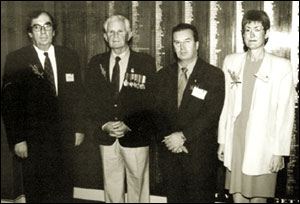
When there have been the various unveilings over the years, they have all been joint activities and I think when Ken Boston … indicated that in going back over the figures, 23 per cent. of teachers were involved in war effort, it certainly shows why it was that these activities were such a priority for all the organisations, why the organisations, to raise the funds, sometimes were in place in various committees of ten years or more …
I was particularly moved by a reference given in the book by Mr Drummond who unveiled the World War II plaque in 1955. He said this: “Each of us recalls some whom we knew as school mates, as college friends, as colleagues in the teaching service, and in some cases, as cobbers on active service.”
Now, we can still say that today. Certainly when I was going through the list of names in the [Soldier-Teacher War Memorial] book, I could recognise a number of names of people I have met in my work as a teacher and with the Federation. Most of those were, of course, names from the Vietnam War. But overall, the book is a reminder of the devastating effect of war on families and communities. It is certainly a reminder of the contribution the occupational groups such as teachers, have played. But the book is also a history of those who not only lost their lives and fought for their country but it is a history of all those who worked together after the wars to make sure that all of us do not forget the horrors of war.70
Mr Stan Bull of the Teachers Sub-Branch then delivered a telling oration. Mr Tony Stewart MP, Parliamentary Secretary (representing the Minister for Education), Dr Boston, Mr Falkenmire and Ms Simpson laid wreaths at the ceremony. Following the saying of the Ode, and the playing of the “Last Post” and “Reveille” by Matthew Bailey of Year 11 at the Conservatorium High School, the gathering sang the hymns “O Valiant Hearts” and “God Save the Queen”. This historic and moving ceremony then concluded with the singing of the National Anthem, accompanied as with the other music by Ms Lisa Taylor of the University of New South Wales.
Afterwards, in a hushed and reverent atmosphere, many from the large gathering lingered near the new honour board and scanned the lists containing the over 2, 500 names of those Departmental employees who served their country in World War II. With the words of the Ode still fresh in their minds from the moving ceremony, there were those who shared a special thought for the many that never returned.
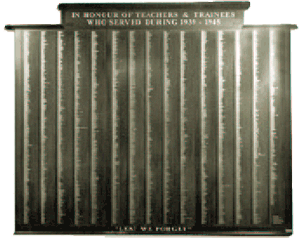
located Level 2, Bridge Street
They went with songs to battle,
they were young,
Straight of limb, true of eye,
Steady and aglow.
They were staunch to the end
against odds uncounted;
They fell with their faces to the foe.
They shall not grow old,
as we who are left grow old;
Age shall not weary them,
nor the years condemn.
At the going down of the sun
and in the morning
We will remember them.
Laurence Binyon (1914)
“For the Fallen”
verses 3 and 4
Lest We Forget