
World War II
Appeal for funds
The President of the Teachers Federation, Sam Lewis, sent an appeal for funds to all schools and in a prominent notice in the 20 July 1949 edition of Education, called on “all Members to give this Soldier Teacher Memorial Appeal their full and generous support.” It is noted that he stated that the appeal had the combined support of the Minister for Education and Departmental officers, the Teachers Sub-Branch, RSS & AILA, and Federation Council, and reminded members of the effective role already played by the Federation in raising money for the erection of Anzac House.29 In August Sam Lewis reported to the Teachers Federation Executive that he had sent a special appeal large schools and associations asking they do all could make success. also appealed councillors on 17 September 8 October in their power It was felt number of not seen circulars.30
By 18 October 1949 Mr F C Clarke, the Treasurer of the Soldier-Teachers Memorial Committee, was able to advise Federation Executive that the memorial fund amounted to 719 pounds, twelve shillings and five pence. He indicated that at the last meeting of the committee it had been decided to conclude the collection of money in schools at the end of October. It had also been decided to send a reminder circular to those schools which had not subscribed. He stated that Mr Edgar (the President of the Teachers Sub-Branch) and he had been released from teaching by the Department for one week in order to visit schools which had not contributed to the fund.31
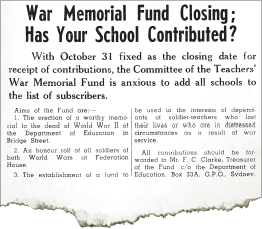
The 14 October 1949 edition of Education carried a notice headed War Memorial Fund Closing; Has Your School Contributed? It reiterated the aims of the fund and stated that the appeal would close on 31 0ctober.32
In late 1949 the Soldier-Teachers Memorial Committee formed a sub-committee consisting of Dr Wyndham, W Edgar, F Clarke and E Lynch to undertake detailed draft planning of the use of 920 pounds approximately collected as a result of the appeal.
On 2 December 1950 Mr Lewis informed Federation Council of the sub-committee’s recommendations relating to Federation House:
That the memorial take the form of
- a bas relief or piece of sculpture that can be fixed to a wall
- a Book of Remembrance containing the names of all our men and women teachers who served in World War I and World War II [and] that the plaque be fixed to the left-hand wall of the Council Hall and the Book of Remembrance be placed on a suitable pedestal and housed in Federation Library.33
It is interesting to note Federation Council’s original recommendation of 21 May 1949 that a plaque containing “the names of all teachers who were in the Armed Services” in both World Wars be placed in Federation House34 had not been taken up. The first meeting of the Soldier-Teachers Memorial Committee had simply resolved on 30 May of the same year that a “suitable memorial [be placed] at Federation House”35, and now the sub-committee had come up with the concept of the Book of Remembrance containing names, and the plaque not containing names. While the sub-committee and not the Federation had suggested this concept, hearsay at the time was that Federation members had come to realise that a bronze plaque containing so many names would have been very large indeed. Hence they were attracted to the idea of a memorial book, a fresh page of which could be on public view each day of the year.
A report in the 13 March 1951 edition of Education stated that Federation Council unanimously adopted the recommendations and agreed that 100 pounds be donated to the Memorial Fund.36 In addition, F Clarke was able to advise Federation Executive early in 1951 that the sub-committee had accepted a quotation of 393 pounds and fifteen shillings from Messrs Powell and Hohnen for the supply and erection of the Department of Education plaque in memory of the dead of World War II. This memorial was to be installed by 25 April 1951. In April 1951 Mr Clarke also advised the Executive that the approximate costs of the other memorials would be: 200 pounds for the Book of Remembrance; 40 pounds for a table for the book; and 200-300 pounds for the memorial in the Council Hall.37