
World War II
Problems
Locating and recording information on World War II personnel
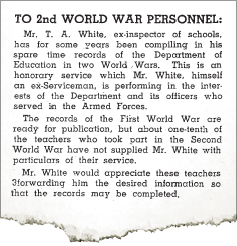
Aproblem faced by the sub-committee concerned obtaining the names of all of those who had served in World War II. There were various sources, including teachers colleges. In March 1952 E Lynch indicated that the list was “still incomplete” but that a final list from one of the sources was expected “very shortly”.38 The 13 March 1951 edition of Education39 carried the following appeal:
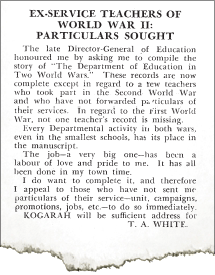
Three years later Mr White was still seeking information on World War II personnel (see the extract on adjoining page).40
It took another nine years before the Book of Remembrance was placed in the Federation Library. Hearsay suggests that the delay was caused by various reasons: ex-service personnel were said to be wary of Bridge Street and its edicts or requests, and some thought the Department’s head office should have had records of the names of all teachers who served; Teachers Colleges had not always kept accurate records of ex-students who joined the forces; and ex-students who joined the forces and did not return to Departmental service did not receive notice of the requests for information. In addition there was talk that the calligrapher set a laudably high but time-consuming standard in recording the many names.
Design delays: the Federation House plaque
Another difficulty related to the design of the memorial plaque to be placed in Federation’s Council Hall. Negotiations with the original sculptor commissioned to submit designs continued during 1951 and 1952. In February 1953 Mr W J Whalan reported to Federation Executive that while the “arrangements are in hand for the Book of Remembrance [and] likewise for the memorial in the Education Department,[the] design has not been finalised for the Federation memorial.”
The Executive decided that it did not consider the design for the Federation House memorial suitable and asked the President and General Secretary to confer with the Teachers Sub-Branch, RSS &AILA.41
Following a long discussion involving the President, the Director-General of Education and Secretary of the Memorial Committee regarding the work carried out by the sculptor, including ideas involving certain modern media, the contract with the sculptor was terminated. A method involving the Director of the National Gallery of NSW (now known as the Art Gallery of NSW) was suggested for determining an equitable payment.
The opinion of Mr (later Emeritus Professor) Bernard Smith, who was consulted regarding the war memorial on the advice of Dr Wyndham, was that wood would be a preferable medium for an interior such as Federation House and he recommended Mr Paul Beadle as an alternative sculptor.
Mr Beadle was an outstanding sculptor and medallist and was a Head Teacher of the School of Art at Newcastle Technical College. He had been a Royal Navy serviceman from 1939-1946 in the Atlantic, Mediterranean and Pacific Fleets, serving in submarines from 1941-1944.42
In April 1953 the Federation President discussed a design for the war memorial with Mr Beadle who had submitted a rough sketch and an estimate of costs. A little over a month later the President submitted a design prepared by Mr Beadle to the Federation Executive, which approved it.43
Further design delays: the Department’s plaque
Despite the resolution of the problem concerning the design of the memorial to be erected in Federation House, there was a delay in finalising the design of the plaque to be placed in the Department’s Bridge Street vestibule. A tender for this had been accepted in 1951. The minutes of the Federation Executive meeting of 23 November 1953 state:
The President reported that the President of the Teachers Sub-Branch of the RSS & AILA had informed him that the delay was due to the fact that the design was not considered satisfactory and that further designs were being obtained from the Officer in Charge of the Design School at the East Sydney Technical College, [Miss Phyllis Shillito].44
Apparently about the same time, Ted Lynch advised the General Secretary of the Teachers Federation that four designs had been prepared during the year, that Miss Shillito was “not happy about any of them” and had sought permission to have further work done during the vacation period. He continued:
When it is in a form acceptable to Miss Shillito, I shall have the artist present it to you and the Director-General. [The artist] will then complete it embodying suggestions we care to recommend. Then we shall call together our Committee.45
The designs were still “being prepared” in mid-February 1954.46
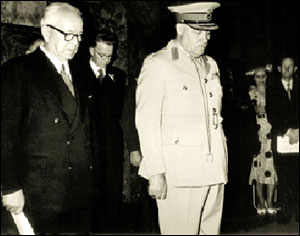
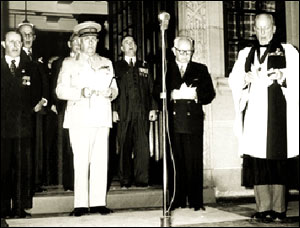
1955: unveiling of the Departmental plaque for the war dead (World War II),
and the Federation House memorial for World War I and
World War II service personnel